


When Sophie was six, she asked me to coach her soccer team.
I had never coached soccer before. But I had filled in during the last game of her previous season… and we won. So, how hard could it be?
Welp.
Turns out, pretty hard.
At that point, I had been coaching my son’s older flag football team and made the playoffs every season. I was used to being the windshield. Teams had to make plans to stop our offense or get through our defense. We were a machine on that field. But with this soccer team?.
We were the bug. Every. Single. Game.
I started the season with one little girl who didn’t want to set foot on the field. At the end of practice, before our first game, I gently pulled her parents aside and suggested they might want to look into a refund.
Not because I didn’t want her there—but because I didn’t want any of us to keep wrestling through the same fight every practice and now in game situations like it was a hostage negotiation. I don’t think a pizza and a helicopter was getting this girl on the field.
The season rolled on. And on. One loss after another.
I tried to keep it in perspective. I was an inexperienced soccer coach, leading a team of 5- and 6-year-olds—
5- and 6-year-olds who argued with me about playing time.
No, not for more playing time. Against it.
I’d say, “Alright buddy, you’re up!”
And I’d hear:
“Nah, I’m good.”
“I’m tired. Let someone else go.”
“Can I just go sit down now?”
These kids weren’t just chill. They were in full-on vacation mode. These kids were basically unionized. Their demands? More sideline time and less cardio. They’d rather be scoring the most flowers picked than setting scoring goals.
One sweet boy made a habit of shaking hands with the other team after they scored—giving them encouraging pats on the back like, “Wow, that was a good goal.” It was precious. It was sportsmanlike. And it was killing our defense.
I was trying to complete a puzzle with pieces from an entirely different box. The image on the lid said “soccer,” but the contents screamed “herding cats with cleats.”
Sophie did manage a hat trick across the final two games of the regular season, which made me proud as a dad. But Coach Me couldn’t help noticing something:
She didn’t have a mean bone in her body.
She wasn’t out there to dominate—she was out there to frolic.
Sometimes literally.
She’d be running down the field holding hands with her friends…while the ball was still in play.
And honestly? It was adorable.
Which, to be fair, is the kind of spirit youth sports could use more of.
At the end of the regular season, every team made the playoffs. Which felt a little like rewarding a GPS for getting you lost. But sure, let’s do it.
This coach was ready to be done.
The imaginary ownership group had already informed me they’d be “going in a different direction” next season. And I was completely on board.
Our first playoff game? Against the undefeated, first-place team.
A team that must’ve had some distant bloodlines tied to Ronaldo, Beckham, and Pelé. They had scored at will all season.
But for whatever reason, they took it easy on us.
By the end of the second period, we were winning.
I was standing on the sideline, rubbing my head and smiling when one of our parents—who was also ready to wrap this circus up—looked over and said,
“We’re gonna mess around and win this.”
I grinned back and said,
“Is it wrong to throw a six-year-old soccer game?”
And for a moment… just a moment… it felt like a Disney movie. Except I didn’t want that happy “We won” ending.
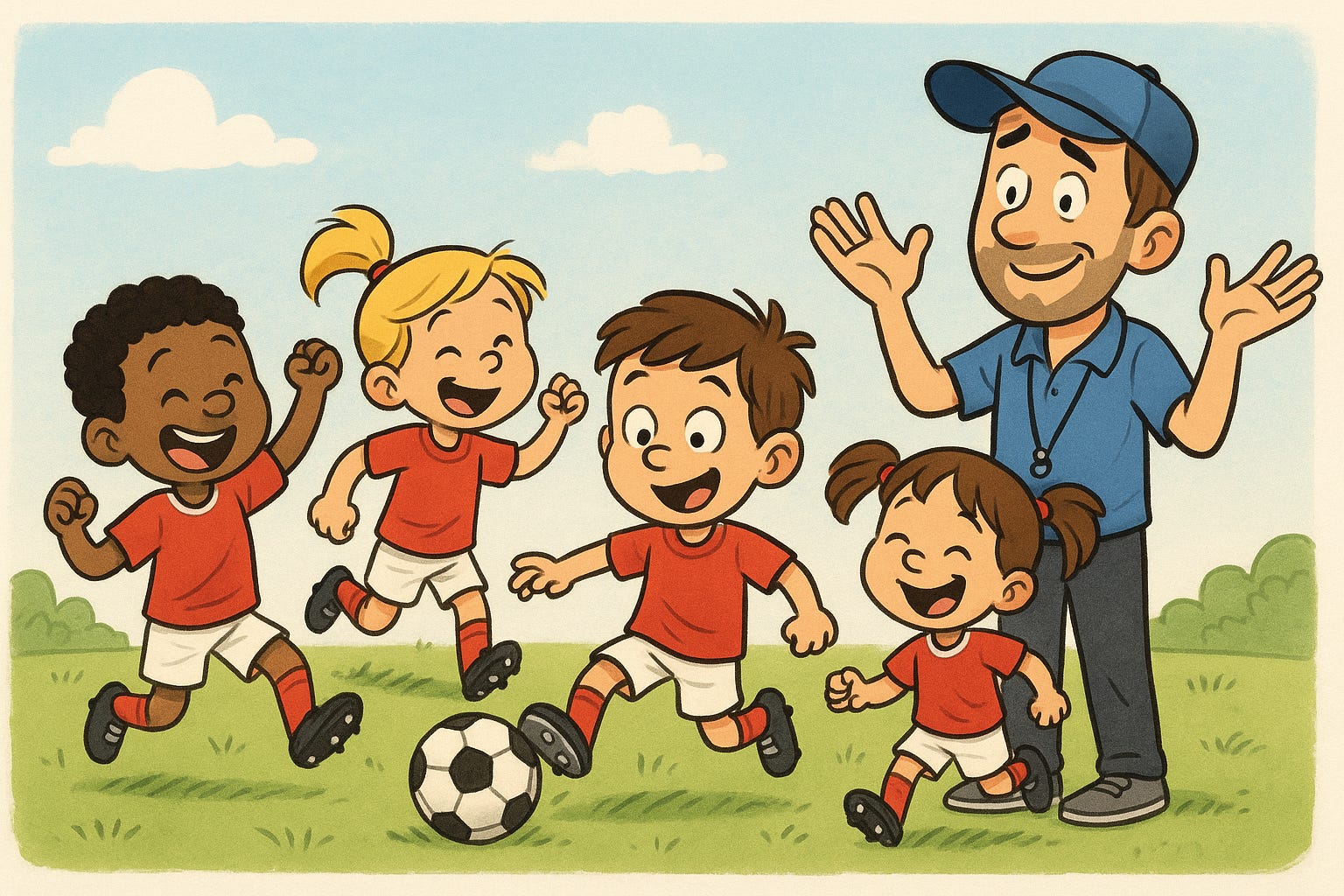
The third period began. And the world returned to its regularly scheduled programming.
That team stopped playing with us like a cat toys with a mouse and hit the kill switch.
We lost.
And the season that refused to end… finally did.
Sometimes I see those kids around town. And they always wave big. They shout “Hi, Coach!” Sophie still talks about the season her Daddy coached her.
And I’m reminded:
At that age, it’s not about trophies or championships.
It’s about the connection.
It’s about the value you give a kid.
That’s a coach’s real job.
Because for me?
Because here’s what I’ve learned: at that age, it’s not about the scoreboard. It’s about what snacks we’re having after the game, the feeling of your jersey flapping in the wind as you run (or walk… or hold hands) down the field, and knowing someone’s cheering just for you.
I never want to be the memory in a kid’s mind of the coach who sacrificed kindness or joy just to relive his own glory days.
The glory days aren’t behind me.
They’re happening right now.And I haven’t peaked quite yet.
🖊️ From the Writer
Thanks for reading another behind-the-scenes story from the sidelines. If you've ever coached little kids, you know it’s not about the X’s and O’s—it’s about snacks, smiles, and surviving with your sense of humor intact.
If this gave you a chuckle or a little heart squeeze, consider sharing it with a friend or parent who’s been there too.
And if you haven’t subscribed yet, well… I promise not to make you run laps or do push-ups.
Subscribe to Grit & Wit
Stories about faith, family, and finding the funny when life gets loud.
Well said!