


Between fourteen and fifteen, I had a growth spurt of about nine inches in one year. Basketball started to feel like my sport. Living on a farm gave my brothers and me plenty of room for baseball, football, basketball, and whatever else we wanted to try. I would spend hours shooting in our backyard and got pretty good at free throws.
That year, we got a new coach—intense didn’t begin to describe him. I was fine with it…until the day he cussed at me during practice. I'd heard cussing before, so no big deal. But, the words he chose just hit me the wrong way. I liked basketball, but I didn’t love it enough to put up with that. So I quit.
Yell at me? Fine. Tell me what I did wrong? Fine. Correct me? Fine. But in my best Tennessee accent, “I ain’t gonna be cussed at and talked to like a dog.” That was about thirty years ago, and to this day, if I see him in a store, I go the other way. He probably wouldn’t even recognize me, but I know what he looks like, and I don’t care to see him. He could have handled things better, and I might have kept playing. His coaching style hurt more than it helped. I can still shoot free throws, but each time I touch a basketball, that memory plays in my head.
And here’s the thing…it happens outside the gym, too.
There are jokes and memes all over the internet about kids being traumatized for “holding the flashlight wrong” while their dad fixed something. It’s funny because it’s true. As fathers, we carry a heavy burden. We’ve got about eighteen years with our kids under our roof to teach them as much as we can. And yes, the tension gets to us sometimes.
But do we really stop and think about how stressful it is to learn something the first time? I try to keep my stress on the inside for the sake of my family. I’ve said before that I want to be the thermostat in my house, not the thermometer.
I’ve seen fathers yell at kids a lot. Sometimes raising your voice is necessary. Let’s be real, there are moments they don’t hear instructions at lower volumes. But I’ve also seen the fear in a child’s eyes, and it has taken every fiber of my being not to step in.
When we handle instruction with frustration or anger, we’re not just teaching a lesson—we’re creating a core memory alongside it. And that memory might not be one they want to replay.
I remember one from my own life. Do you know how to change a tire? No one ever taught me. I learned during a job delivering medicine…in a downpour. The store’s Chevy S10 had a flat, and this was before cell phones. I got out and changed it in the rain, scared the mud would slip the truck off the jack. To this day, I remember the rain running down my face. That’s a core memory.
Another memory from that job? Learning my way around town from two older gentlemen. The first one yelled every time I missed a turn. I eventually asked my boss if I could just learn alone because I was scared to drive with him. The second man? Uber laid-back. If I missed a turn, he’d calmly say, “Now I would have taken that road back there, but you can just take the next right.” Ten times easier to learn from. The difference was in the delivery.
That’s why, when I teach my kids, I don’t just want them to remember the lesson. I want them to remember the experience of learning it.
One time, I had to change a part inside the toilet in my oldest son’s bathroom. I’d done it several times before, but I thought, “This time, he’s going to learn.” I laid out the tools, prompted him to ask questions, and encouraged him to figure things out himself. It took some time, but he did it. He went downstairs and told his mama, proud as could be. And so was I.
Away from home, I’ve coached baseball, soccer, and flag football. I never yelled at a kid. Correction? Sure. Yelling? Never—it rattles most kids and creates anxiety.
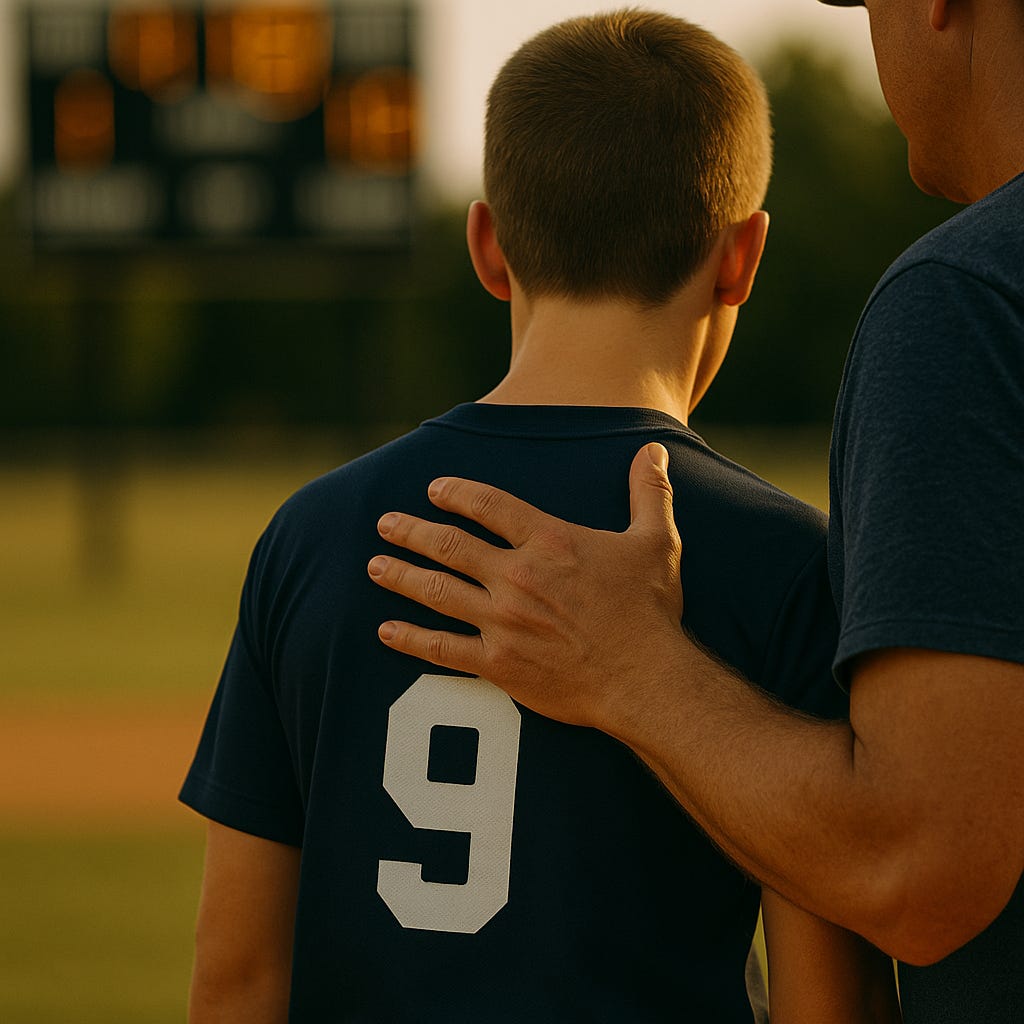
One year, I was coaching Brighton’s team on defense. In our final game of an undefeated season, I pulled him with a minute left. He thought it was because of a mistake. He stiffened beside me on the sideline. I put my arm around him, pulled him close, and whispered, “The reason I pulled you is because I wanted you standing next to me when that clock hits zero.”
His whole demeanor changed. He smiled, stood up straighter, and said, “Thank you.” That’s a core memory for both of us.
Teaching the lesson is easy—anyone can show someone how to do something. But living the lesson? That’s a whole different story.
Our kids won’t believe a word we say if we don’t live out the life we’re teaching. Ask any parent—most kids will call out hypocrisy in a second. And I’m okay with that. It means they’re paying attention. It means they’re thinking for themselves, determining right from wrong, and starting conversations about the why’s.
Jesus taught that way, too. He often told stories, like the one about the Good Samaritan (Luke 10:25–37). It started when a man asked Jesus what he had to do to inherit eternal life. Jesus told him to love God and love his neighbor. Then the man asked, “And who is my neighbor?”
Instead of giving a simple answer, Jesus told a story. In it, the “good guy” was the one no one expected—someone who had every reason to keep walking, but instead stopped, helped, and made sure the man was cared for. That story didn’t just tell people what to do—it made them think, feel, and remember.
When you’re teaching a child, a friend, or a colleague, put yourself in their place. Remember the nervousness, the doubts, the desire to get it right. Then ask yourself: How do I want them to feel about themselves after the lesson? Full of doubt? Or full of confidence, carrying a lesson and a positive core memory with it?
The way we teach shapes more than the lesson—it shapes the memory. So be the mentor you wished you had, or emulate the awesome one you did.
This is great stuff, Maury!
Father God,
Please let Maury know he was just used rather spectacularly in whatever way you talk to him. I know we all communicate with you differently. If it’s your will, it would be cool if it was extra loud and boisterous—-whatever that is for him. You are my everything, so that includes my megaphone🤗.
Thank you for all your Substack kiddos and the way I feel your presence in so much of their writing. You know my prayers for all of them. Thank you, again, for giving us a quasi-heavenly Ethernet playground.
As much as I am digging it, I still need that wisdom regarding how to best invest my “playtime”. I see why you brought me here, but you know how I pour out, too. You are my scale and I need your wisdom to know the balance. I love you. 💜✝️💜