

Before Faith With Work Boots On, I had started writing another book based on a letter my Grandma wrote to me on my eighteenth birthday. I’ve put it on pause for a while, but it has some really good stories that keep calling me back.
This is one of them.
“You have growed up in a whole different world of things than we did. Just think the good things you have. Running water and a bathroom. Flip a switch and a light will come on. Electricity. Heat. Wonder we hadn’t froze.”
— Grandma Pauline
Wood Dairy and Sons is what provided for my upbringing.
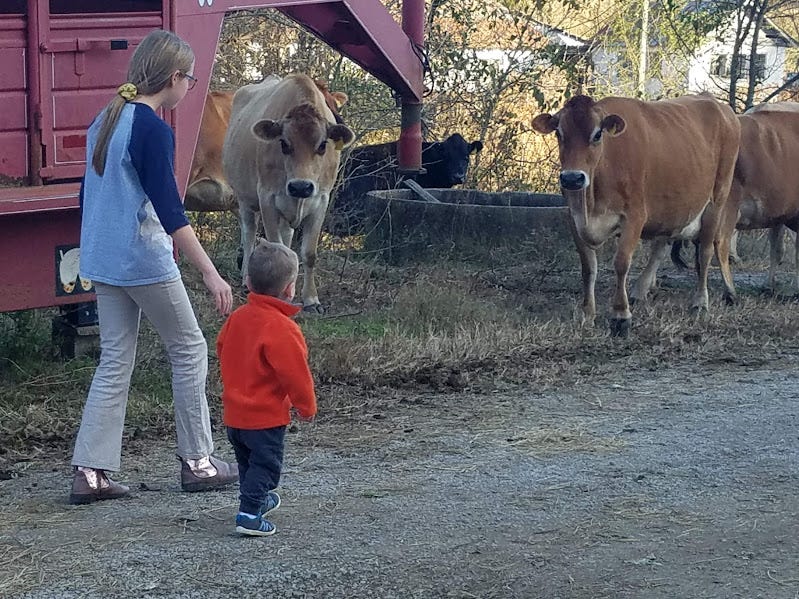
My daddy milked cows twice a day with my uncle and Paw Paw. Twice. A. Day. There were no days off, no sleeping in on the weekends. The only real breaks we had were the occasional trip to Gatlinburg in the summer, and even then, it took some serious coordination. On Christmas morning, we didn’t tear into presents at the crack of dawn like other kids. First, Daddy had to finish milking and check the furnace for wood before he came inside. That was life. And at the time, I didn’t think much of it—other than maybe feeling a little impatient while waiting. Honestly, it made Christmas last a little bit longer.
I had the kind of childhood where walking into a milk barn was normal. It was loud. It was cold in the winter and hot in the summer. It smelled like cows and we’ll just say “other stuff.” It was honest, backbreaking work that happened whether you were tired or not, whether it was Christmas or Tuesday, rain or shine. My brothers and I did not milk many cows growing up because whenever we were in the barn, the cows focused more on us then they did their job.
Before the dairy farm, my grandfather lived on his family’s land. Paw Paw used to tell stories about how the interstate cut their original family farm in half. I can still hear the aggravation in his voice when he talked about men showing up with clipboards, putting a price on land and equipment they didn’t even understand. They didn’t know the name of a single piece of equipment or how much hay that pasture had yielded last year—but they still named a price and took it.
Paw Paw would explain, “Those men said I could build new barns. I said that I liked the ones I got. Giving me prices for things that they didn’t even know what they were.” If you wanted to see the rare fire in Paw Paw’s eyes, just bring up the interstate.
So he and Grandma started over a few miles away. They bought the farm that I spent a lot of time growing up on and that my brother still lives on today and built a new life. Piece by piece. That’s when Wood Dairy and Sons really became more than a name. It was a legacy.
I grew up eating from our garden. We had a deep freeze full of beef—from hamburger to steaks—and fresh milk we didn’t have to buy in a jug. Mama only went to the store for staples. I joke now that I grew up eating organic before it was trendy. No one called it “farm to table.” It was just dinner.
I also grew up in a farmhouse almost one hundred years old that was cooled by window units. It was a bigger, older house, and in the summer, we’d have to shut the doors to rooms we weren’t using that much so we could trap the cool air in the parts we lived in. At the time, it never occurred to me that we were doing something special. That was just life. Now, I look back and see the ingenuity. The sacrifice. The quiet efficiency of making do with what you had and doing it without complaint.
Funny side-note—While we were on vacation, we would keep our hotel rooms like they were a meat locker. We took advantage of that air conditioner.
Grandma and Paw Paw gave me a piece of advice before I got married that stuck with me. They said a lot of people get married expecting to have everything their parents have, right away, without realizing it took their parents decades to build that kind of life. That wisdom didn’t fully land until I had a mortgage, bills, and a minivan with goldfish crackers and crayons buried in between the seats.
When Grandma passed away, I stood next to Paw Paw at the funeral home during visitation. He was about ninety. Frail, but still strong in the ways that matter. He had a hump in his back, the result of a barn loft fall as a kid that never healed right. He told me he was supposed to stay in bed for weeks to recover and let his spine straighten back out, but life on a farm doesn’t wait on anything. So he got up and kept going. Fences needed mending. Cows needed milking. Work needed doing.
I remember hugging him as a boy and feeling that hump in his back. I asked him about it once. Just once. After he told me the story, I never brought it up again.
That day at the funeral home, as he stood looking at the woman he’d loved for over fifty years, he said quietly, “I don’t know how people go through tough times like this without God, family and people around them.”
I didn’t have anything profound to say. I just put my arm around him, patted his back, and said, “Me neither, Paw Paw. Me neither.”
Reflection: “Want” is not evil, but it isn’t wise either.
As a kid, I didn’t get it. Not really.
The “want” in me wasn’t evil, but it wasn’t exactly wise either. I didn’t understand that money paid for everything—not just toys and fast food, but things like electricity, insurance, and gas we got regularly at the Co-Op. I didn’t understand why sometimes we had to say no. Or why Mama bought the store-brand at times. Or why Daddy worked so many hours. I had a very blessed childhood, but not one built on excess. We were comfortable. My parents took great care of me and my two brothers.
Now, as a dad, I see it differently. Completely.
When Karen and I got married, we had one of those “grocery budget” conversations early on. I remember telling her we didn’t need to buy much meat when I was younger because we always had a freezer full. That’s when it hit me—my childhood wasn’t just good. It was different. Mama bought only the essentials at the store because everything else came from the farm: garden veggies, milk, and beef. We still had to get eggs because our farm lacked chickens.
I still carry that mindset. I believe hard work gives value to what we have. If it’s handed to you, it doesn’t mean as much. Sometimes you don’t take care of it like you should.
I want my kids to know that.
It’s hard for them to imagine a world where you had to hang clothes on a line to dry or go outside to use the bathroom (I did not, but Paw Paw and Grandma did). And while I’m thankful they haven’t had to live through that kind of inconvenience, I do want them to understand the effort behind comfort.
Where I live now, my Grandma would probably say she’s very proud of me. But I still mow my own yard. I know plenty of people pay for landscaping. My brother even built a business off of it. Nothing wrong with that. But if I have the time and the energy to do it myself, I do it. I’ve said that to my kids before and gotten a few eye rolls. I just smile and keep pushing the mower or fixing whatever needs fixing at the moment.
Same thing with going to eat. These days, we’d rather eat at our own kitchen table than go to a restaurant. The food might not come on fancy plates all the time, but it’s cooked with love—and for us. One of our kids asked if we could eat supper outside recently. We did. In the middle of the meal, they looked around and said, “This is nice.”
They were right. It was.
It’s not about the convenience. It’s about the connection. The care. Karen’s cooking is amazing—not because it’s gourmet (it is the best) but because it’s made with intention. And that intention matters more than anything on a menu.
I’ve also learned how to fix a lot of things around the house thanks to my stepdad, Tom. I’m trying to show my kids how much we save as a family by installing appliances or repairing things myself. That’s money we can spend on what we need and want.
You could say I’ve traded the farm life for a house on less than an acre. But let’s be honest: you can take the boy out of the country, but you can’t take the country out of the boy. I am proud that most people can tell I grew up in a rural part of Tennessee.
These days, when I’m mowing, and I catch a whiff of fresh-cut grass, it’s about as close to the smell of hay as I get now. And when a diesel truck drives by, I think of stepping off the school bus and heading out to rake hay with Paw Paw. That smell brings it all back. The rhythm. The work. The way they helped raise me by instilling a good work ethic.
My life now is easier in a lot of ways than Grandma and Paw Paw’s ever was. But because of them, I recognize blessings differently now.
I know wealth isn’t always measured in money. Sometimes it looks like a freezer full of beef, a garden out back, parents who showed up every day, and grandparents who taught you how to work without ever calling it a lesson.
Sometimes it smells like diesel fuel and fresh-cut hay.
Sometimes it sounds like your Mama calling from the back porch that supper’s almost ready.
And sometimes, the richest parts of your childhood are the things you don’t fully appreciate until years later.
Paw Paw told me before he passed that I had a great family and to “keep it up.” That meant more to me than he probably knew. I think he and Grandma would say I’ve grown into a good man. Not because life’s been easy but because their legacy taught me how to live well, love hard, and never forget where I came from.
I want my kids to carry that with them. I think they are. They say thank you a lot. They notice when things are fixed or meals are made. They know things don’t just show up—they take effort.
And maybe one day, when my kids are raising kids of their own, they’ll look back and realize what I’ve come to know for sure:
Hard isn’t bad. Sometimes it’s just holy.
I only had weekends on my grandparents' farm, but everything you shared with us ... me too!
I can't wait to read it again in your next book.
Thanks for these memories, Maury. I grew up in a small town, but my cousins lived on a farm a few miles away and they had dairy cows when I was young. It was always an adventure hanging out with them. I was always sad that my children didn't get to have that experience. Thanks for sharing!