


Memorial Day has always felt more reflective than celebratory to me.
A few years ago, our family lost a man named Mr. Paul. He wasn’t related to us by blood, but somewhere along the way, he became family anyway.
The older I get, the more I realize men like him shaped far more of this country than they ever got credit for.
If you walked into the room, you might not have noticed him right away.
Mr. Paul was usually sitting quietly in a recliner in the corner, his black 101st Airborne hat sitting on top of his head as he simply took it all in. His eyes were always moving behind his glasses, observing, aware, present. Not nervous. Just attentive. Like someone who had spent a lifetime learning to pay attention to the world around him.
My Mama introduced him to us as “Mr. Paul,” and that’s what he became to our family. My kids called him “sir” first and foremost out of respect. Around our house, he was never “the war hero” or “the veteran.” He was just Mr. Paul.
And honestly, I think he liked it that way.
At any gathering we had, if Mama and Tom invited him, he would come. He didn’t really have a designated spot in the house, but we all knew the recliner was his. If one of the kids was sitting there when he walked in, they got up without being asked. It was just understood.
He was talkative and quiet at the same time, if that makes sense. He wasn’t a loud personality. He never made things about himself. But if you sat down beside him and asked about World War II, he would answer without hesitation. His voice sounded like someone who had lived a long life because he had. If wisdom had a tone, he had it.
I never saw him wear anything except that black 101st Airborne hat.
My youngest kids would run up to him with drawings or whatever toy they were obsessed with that week. He would take it carefully in his hands, look it over like it mattered, smile, and hand it back. Sometimes they would just grin at each other for a second like old friends.
They felt seen by him.
He was like an extra grandpa they got to have.
Karen always made sure he didn’t have to fix his own plate or carry it back to the kitchen when he finished eating. He was very mannerly and always appreciative. He would smile softly and say, “Thank you.”
That’s the picture I still see when I think about him.
Not the war stories.
Not the battles.
Just Mr. Paul sitting quietly in a room full of family, wearing his 101st hat while children showed him toys and drawings.
Then one day, my Mama and Tom started telling me more about his story.
And oh boy.
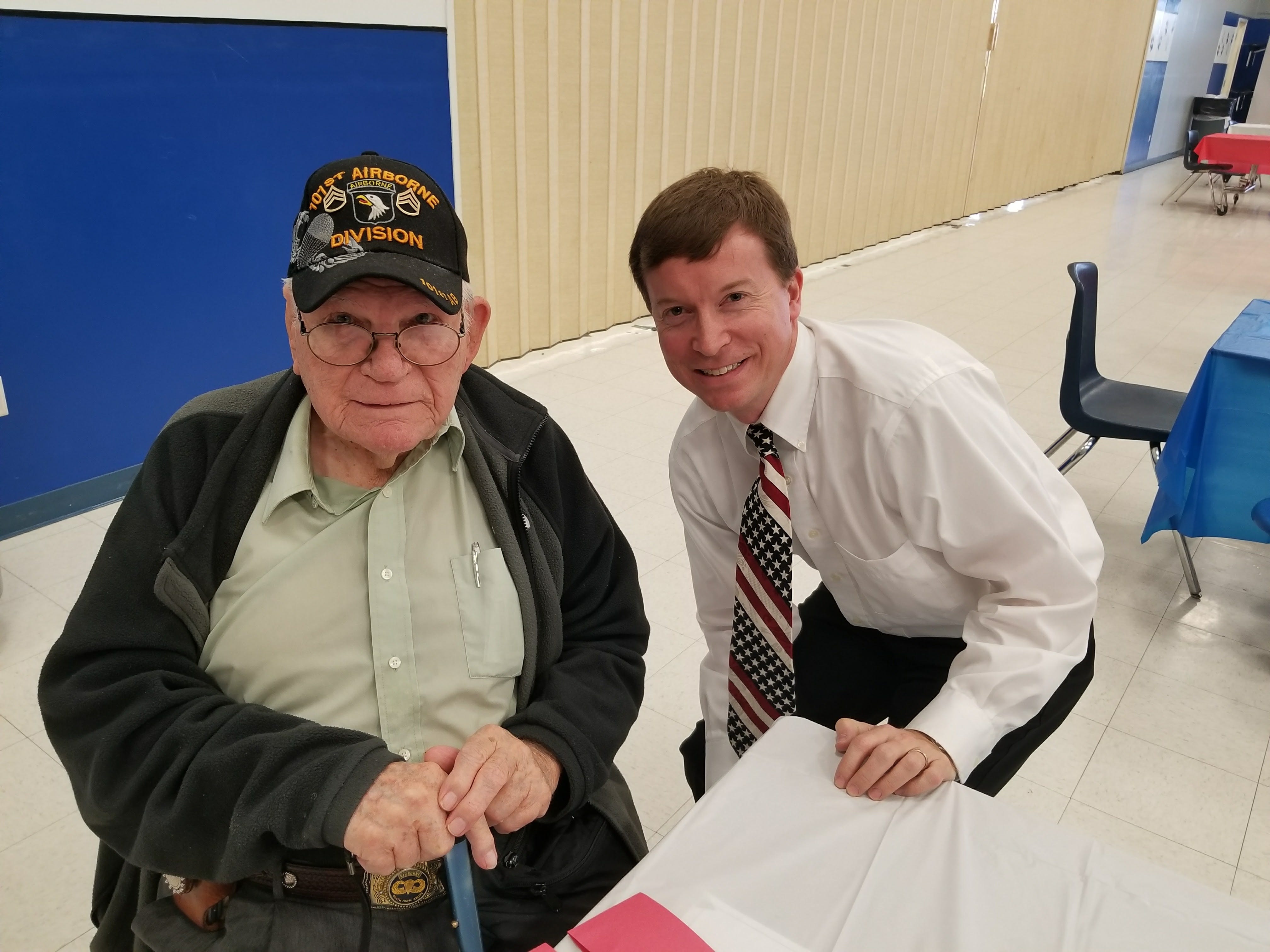
Paul Jackson was a World War II veteran in the 101st Airborne Division. After Pearl Harbor, he was stationed in California, but he felt called to do more. He requested to become a paratrooper. At the time, he was a staff sergeant, but his commanding officer denied the request.
Eventually, his former commander, General George Patton, intervened and Paul was allowed to transfer. But there was a cost. His captain stripped him of his rank.
At 21 years old, Paul willingly took a demotion from staff sergeant to corporal because he believed it was the right thing to do.
That tells you almost everything you need to know about the man right there.
He parachuted into Normandy on D-Day knowing full well it might be the last jump of his life. He fought in multiple battles across Europe and later jumped into Operation Market Garden, where he was wounded after a tank took a direct hit nearby.
Despite being injured, he climbed a hill, spotted an enemy rocket launcher team, and took out five soldiers by himself.
By himself.
Then came the Battle of the Bulge.
In the bitter cold of Bastogne, Paul was shot three times in the hip. He spent five months in the hospital before being honorably discharged from the 101st Airborne in 1945.
And yet…if you met him later in life, you would have never guessed the depth of what he had lived through.
He didn’t walk easily anymore. His movement was slow and deliberate. He got from Point A to Point B with as few footsteps as possible. Sometimes he would steady himself using furniture, or one of us would help him.
His body definitely remembered the war.
But he never carried himself like anyone owed him something because of it.
One time he bought one of those “high-tech” televisions and asked me to come hook it up for him. I went over to his apartment, which was neat, clean, and simple. There was an American flag hanging on the wall. Nothing flashy. Nothing dramatic. Just a quiet apartment where an old soldier liked watching boxing and UFC fights on television.
After I got everything connected, he pulled out his wallet to pay me.
I laughed and told him there was no way I was taking money for hooking up a TV.
But he insisted for a moment because, to him, time and effort mattered. Gratitude mattered.
That generation understood something about humility.
Paul always thanked people when they thanked him for his service. His eyebrows would raise slightly, he would shake their hand, and quietly say, “Thank you.”
Not because he wanted attention.
Honestly, I think he was uncomfortable with attention.
He was just raised to show respect.
The older I get, the more I appreciate men like that.
Today, everything feels loud. Everybody is broadcasting themselves. Everybody wants recognition. Everybody wants credit.
But the strongest men I’ve ever known usually didn’t spend much time telling you how strong they were. Men like Paul simply did the right thing because they believed it was the right thing to do.
Even when it cost them.
Even when it hurt.
Even when nobody applauded.
I think that’s one reason Memorial Day matters so much.
It’s not just a long weekend. It’s not just cookouts and mattress sales.
It’s remembrance.
Not necessarily sadness, but respectful reflection.
Because freedom has names and faces attached to it.
Sometimes it looks like a 21-year-old paratrooper jumping into Normandy.
And sometimes it looks like an old man sitting quietly in a recliner while little kids show him small car and trucks or stuff animals.
I hope my children remember that.
I hope they remember that courage is not always loud.
I hope they remember that humility makes bravery even more powerful.
I hope they remember that Mr. Paul did the right thing even when the right thing was hard.
And I hope they remember that some of the greatest heroes you’ll ever meet might simply be sitting quietly in the corner of the room, smiling at children, saying “thank you,” while carrying stories most of us could never imagine.
Sometimes the only thank you people like that may ever fully receive will be in heaven one day.
And somehow, I think Mr. Paul would have been perfectly OK with that.
If you’re new here, Grit & Wit is where I write about faith, family, humor, legacy, and the kinds of ordinary people who leave lasting marks on our lives.
Great story of a great man. Thank you for sharing, Maury!
My grandson will love hearing this story. Thank you for sharing it with us.