



Have you ever gotten a rock in your shoe?
I’m not talking about one of those big rocks that makes you stop immediately. I’m talking about a little pebble that somehow finds its way inside your shoe and settles somewhere around your heel or under your toes.
You can walk around with it for a while. Sometimes you don’t even notice it. But then you step a certain way, and there it is again. You might shake your foot a little, hoping it’ll move somewhere less annoying, but eventually you have to stop, take off your shoe, and get rid of the thing. Sometimes you even have to shake more than once and really hard to get the little thing out.
During our Life Group discussion Sunday, Micah compared unforgiveness to walking around with a rock in your shoe. It doesn’t necessarily hurt with every step, but it’s always there, waiting for the next time you step just right.
I knew exactly what he meant.
I’ve mentioned before that I have a pretty good memory. Sometimes I think it’s more of a curse than a blessing. My memories don’t just come back as little pieces of information. They tend to play like movies, complete with the conversations, the people involved, and sometimes the feelings that went along with them.
That can be a wonderful thing when I’m remembering Christmas mornings as a kid or something funny one of my children said years ago. But it can also mean remembering things I’d just as soon leave in the past.
I’ve had people hurt me over the years, just like everybody else. Some of those people probably don’t even realize they did anything wrong or think they did anything wrong. They may genuinely believe they did everything they were supposed to do, never realizing that something important was missing or that their actions left a mark.
And here’s something I’ve had to learn as I’ve gotten older: I may never receive an apology for something the other person doesn’t even recognize.
For a long time, I think we convince ourselves that forgiveness requires the other person to acknowledge what happened. We want them to admit they were wrong. We want an apology, preferably a sincere one, and maybe even some recognition of how much their actions affected us.
That would certainly make forgiveness easier.
But Jesus never said we only had to forgive people who asked nicely.
This week, our church continued its series on the Lord’s Prayer, and we arrived at Matthew 6:12:
“And forgive us our debts, as we also have forgiven our debtors.”
Of all the things Jesus could have included when teaching His disciples to pray, He made sure forgiveness was part of it. Not just asking God to forgive us, but acknowledging our responsibility to forgive others. The pastor went as far as to say he thinks this verse is the thesis of the Lord’s Prayer.
That’s where things get uncomfortable.
It’s one thing to ask God to forgive the things I’ve done wrong. I know I need His forgiveness. I know I’m not perfect, and I’m certainly grateful that His grace doesn’t depend on me getting everything right.
But forgiving somebody else? Especially somebody who really did hurt me?
That’s a different conversation.
Our guest pastor Sunday, Alex Himaya, talked about Joseph. I’ve written about Joseph before because his story is one of my favorites in Scripture. If anybody had a reason to hold a grudge, Joseph certainly did. If you lined up the major characters in the Bible, he would certainly get a pass for holding a grudge.
His brothers hated him, threw him into a pit, and sold him into slavery. He ended up in Egypt, was falsely accused, and spent time in prison for something he didn’t do. Twelve long years. Meanwhile, his family back home believed he was dead.
It’s safe to say that Joseph went through some stuff.

Eventually, God elevated Joseph to a position of tremendous authority in Egypt. He went from being a prisoner to being one of the most powerful men in the country.
And years later, when famine drove his brothers to Egypt looking for food, they found themselves standing in front of the very brother they had betrayed. Only they didn’t recognize him. But…Joseph recognized them immediately.
Think about that for a minute. The men responsible for so much pain in his life were standing right in front of him, and he had the power to do just about anything he wanted with a single word.
When I taught Joseph’s story years ago, I used to tell my students that Joseph could have snapped his fingers and had his brothers punished. He had that kind of authority. Nobody in Egypt was going to question him for dealing harshly with a group of foreigners.
And from a human perspective, who would have blamed him?
Instead, Joseph eventually revealed himself to his brothers and told them not to be distressed or angry with themselves for selling him into slavery. In Genesis 45:5, he recognized that God had worked through what happened to preserve lives.
Joseph wasn’t saying what his brothers did was acceptable. Selling your brother into slavery doesn’t become a good thing just because God eventually brings something good out of it. But Joseph had gained something his brothers didn’t have when they threw him into that pit.
Perspective.
He could see that the worst things other people had done to him had not prevented God from working in his life.
One thing Pastor Alex mentioned Sunday was that once Joseph had been released from prison and risen to power, he had the resources to return home. Scripture doesn’t tell us why he didn’t. I had never really considered that question before. Whatever the reason, when his brothers finally stood before him, Joseph faced a decision. He could use his position to settle an old score, or he could choose another way.
What impresses me most isn’t simply that Joseph eventually forgave them. It’s that he had the power to retaliate and chose not to. That takes a different kind of strength.
I think we sometimes confuse forgiveness with pretending something didn’t happen. We think forgiving someone means we have to forget the hurt, excuse the behavior, or immediately return to the relationship we had before.
But forgiveness doesn’t require us to rewrite history. It doesn’t mean there are never consequences, and it doesn’t mean we have to place ourselves back into situations where someone can continue hurting us.
It means we make a deliberate decision not to allow that hurt to become the controlling force in our lives.
For me, that decision isn’t always made just once.
I can forgive somebody and go months without giving the situation another thought. Then I’ll see something, hear a name, or remember a conversation, and suddenly that old movie starts playing again.
There’s the rock in my shoe.
I’ve learned that I have to take those moments to God. Sometimes I have to talk to Him about the same hurt I’ve already surrendered before. I have to remind myself that I’ve chosen forgiveness and ask Him to help me keep my perspective where it belongs.
I can’t control what somebody else did. I can’t make them recognize it, apologize for it, or even understand why it mattered to me. But I can control how I respond today. As my Christian walk has matured, I’ve realized that forgiveness is something I have to choose deliberately. And sometimes I have to keep choosing it. Over and over again.
That doesn’t mean the first decision wasn’t genuine. It means I’m still human, and some memories take longer than others to stop bothering us.
I also think forgiveness is something we learn by watching other people. Before Joseph’s brothers ever sold him into slavery, his father Jacob had his own experience with forgiveness. Jacob had wronged his brother Esau, and years later, when the two were about to meet again, Jacob was terrified of what Esau might do. When you hear your brother is coming with 400 soldiers, you tend to start believing you were right.
Instead, Genesis 33 tells us that Esau ran to meet Jacob, embraced him, and kissed him. The brothers wept together.
Joseph was part of that family, and the reconciliation between Jacob and Esau was part of his family’s history. Scripture doesn’t tell us exactly what Joseph took away from it, but it reminds me of something important.
Forgiveness can be contagious.
So can unforgiveness.
Think about what happens in a family where everybody keeps score. A husband remembers something his wife said three years ago and brings it up during an argument. A wife keeps a mental list of every time her husband disappointed her. Parents remind their children of mistakes they’ve already apologized for.
Before long, everybody is carrying around a pocketful of rocks.
Karen and I have been married for a while now, and I can promise you we’ve both had plenty of opportunities to forgive each other. We’ve said things we shouldn’t have said, misunderstood each other, and probably been convinced we were right when we weren’t.
That’s part of two imperfect people building a life together. But if we spend our marriage keeping track of every wrong, we’re going to miss an awful lot of the good God has given us.
And our children are watching.
They’re watching how we handle disagreements. They’re watching whether we apologize when we’re wrong. They’re watching whether we extend grace or keep bringing up old mistakes.
I want my children to understand that forgiveness doesn’t mean somebody gets a free pass to hurt you repeatedly. But I also want them to see that we don’t have to carry every offense with us for the rest of our lives. I want them to know that being right isn’t always the most important thing in a relationship.
Now, don’t misunderstand me. Some people seem determined to make that difficult.
There’s a line from The Dark Knight that I’ve always liked. Alfred tells Bruce Wayne, “Some men just want to watch the world burn.”
I’ve met a few people who seemed determined to prove Alfred right.
Some people don’t want a resolution. They want an argument. They want the scene. They want the drama. They don’t particularly care whether they’re right or wrong as long as they get the last word.
But even then, I have a choice. I can spend my time trying to win an argument that nobody was ever going to win, or I can step away and refuse to let somebody else’s attitude determine mine.
And sometimes the best thing I can do is pray for that person and walk away.
I’ve prayed for people over the years when my attitude toward them wasn’t what it should have been. Sometimes those prayers started out with me wanting God to straighten them out. But somewhere along the way, God began straightening out my heart instead.
That’s one of the things I find fascinating about intercessory prayer. When we pray for someone else, God may be doing just as much work in us as He is in the person we’re praying for. We begin seeing them differently. Maybe we recognize they’re carrying struggles we know nothing about. Maybe we become less interested in proving them wrong and more interested in showing them grace. Or maybe God simply helps us put down a burden we were never meant to carry indefinitely.
Ultimately, though, the greatest example of forgiveness isn’t Joseph or Esau or anybody else in the Old Testament.
It’s Jesus.
As He hung on the cross, suffering at the hands of the very people who had condemned Him, Jesus prayed, “Father, forgive them, for they do not know what they are doing.” (Luke 23:34)
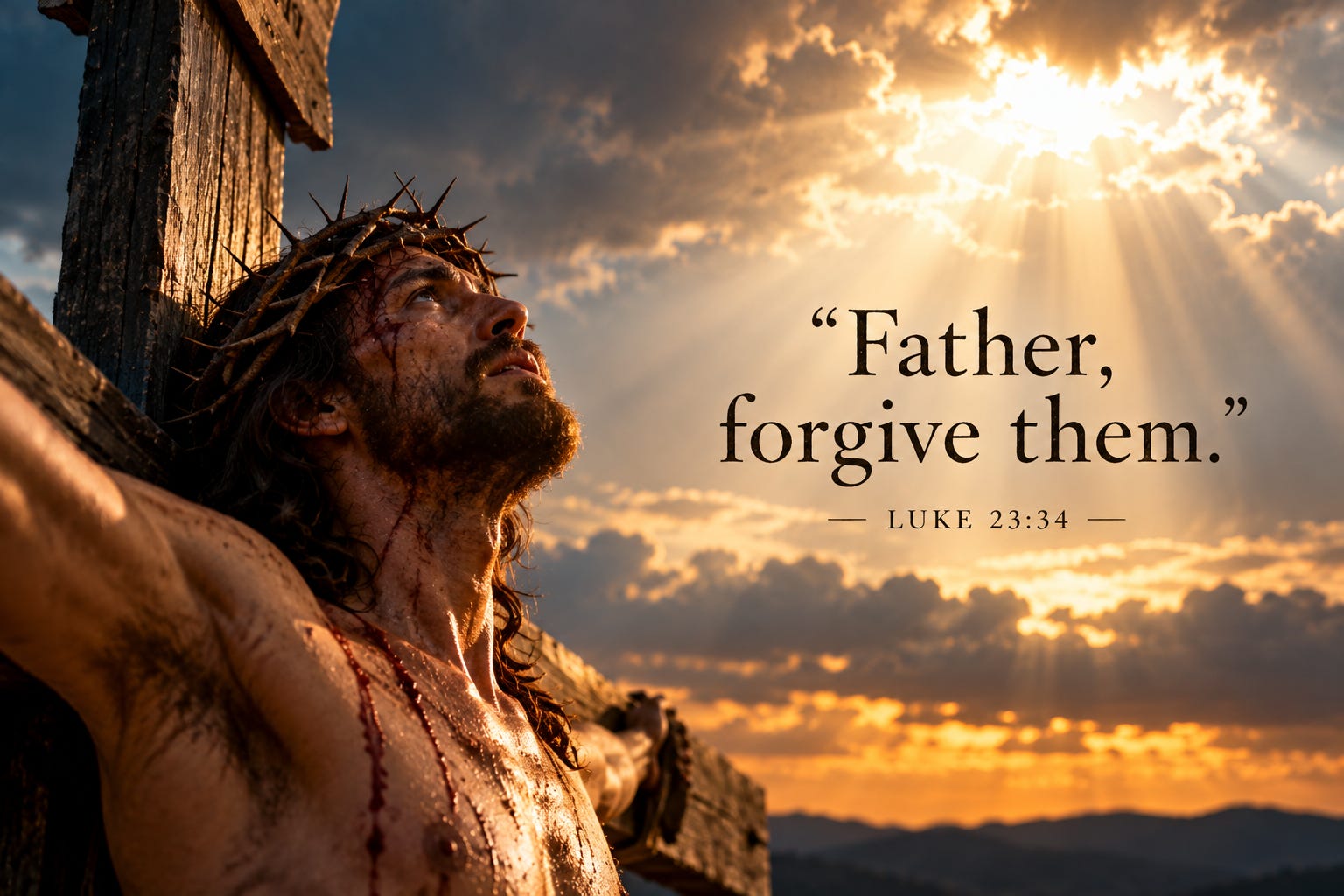
He wasn’t speaking about some minor misunderstanding. He had been tortured and when Jesus was saying this, He was being crucified.
And He prayed for forgiveness.
I think about that when I read Matthew 6:12. Jesus taught us to ask the Father to forgive our debts as we forgive those who owe us. Then He demonstrated the kind of mercy He was talking about.
None of us comes to God with a spotless record. We’ve all sinned. We’ve all fallen short. We’ve all needed grace we could never earn. I have heard grace described as God’s riches at Christ’s expense. G.R.A.C.E.
And through Jesus Christ, God offers us forgiveness.
If I’m willing to receive that kind of mercy, I have to be willing to extend mercy to others.
That doesn’t mean forgiveness will always be easy. Some wounds are deep, and some situations require time, prayer, wise counsel, and healthy boundaries. But the difficulty doesn’t change what Jesus calls us to do.
It brings me back to that little rock in my shoe. I don’t have to keep carrying it just because somebody else put it there. And if the memory returns tomorrow, I can take it to God again. I can remember what happened without allowing it to determine what happens next. I can choose to treat people with grace, especially the people closest to me, because I’ve received more grace than I could ever deserve.
Micah’s illustration made me think about how much time we can spend walking around with something that keeps hurting us when we could stop and deal with it.
Sometimes forgiveness doesn’t change the person who hurt us. They may never know we forgave them.
But it changes us. It changes what we’re willing to carry.
And I’d much rather spend the rest of my life walking in the freedom Christ has given me than limping along with a rock in my shoe.
Wouldn’t you?
Live It
Think about someone whose words or actions still bother you when you remember them. Maybe the hurt happened recently, or maybe you’ve been carrying it for years.
Ask yourself whether you’re holding onto the memory because there’s something you still need to address, or whether you’ve simply become accustomed to carrying the hurt.
Take it to God. Tell Him what happened and how you feel about it. Ask Him to help you see the situation with the perspective He wants you to have.
If you need to forgive someone, begin there. If you’ve already forgiven them but the memory keeps returning, ask God to help you continue walking in that forgiveness.
And remember, forgiveness doesn’t always require restoring a relationship to what it was. You can forgive someone while maintaining necessary boundaries.
Go Deeper
Why do you think Jesus connects our willingness to forgive others with our own need for forgiveness in Matthew 6:12–14?
Is there a hurt I’ve been carrying that has become like a rock in my shoe?
Have I been waiting for an apology before allowing myself to forgive someone?
What’s the difference between forgiving someone and pretending what happened didn’t matter?
When an old hurt comes back to mind, how do I usually respond? Do I replay it, or do I bring it to God?
What are my children, spouse, friends, or coworkers learning about forgiveness by watching me?
Is there someone I need to begin praying for, even if my feelings toward that person haven’t changed yet?
Dinner Table Devotional
Read: Matthew 6:12 and Colossians 3:13
Talk About It:
Have you ever gotten a rock in your shoe? What did you do to get it out?
How can holding onto anger or hurt be like walking around with a rock in your shoe?
Why is it sometimes hard to forgive someone who has hurt our feelings?
Does forgiving someone mean what they did was okay? Why or why not?
How can we show forgiveness to each other in our family?
Why should remembering how much Jesus has forgiven us help us forgive others?
Pray Together:
Father, thank You for loving us and forgiving us even when we don’t deserve it. Help us show that same grace to the people around us. When someone hurts us, give us wisdom to respond in a way that honors You. Help us forgive without pretending that wrong things are right, and remind us to bring our hurts to You instead of carrying them alone. Teach our family to be quick to apologize, willing to forgive, and faithful in showing the love of Jesus. In the great big name of Jesus we pray, Amen.