


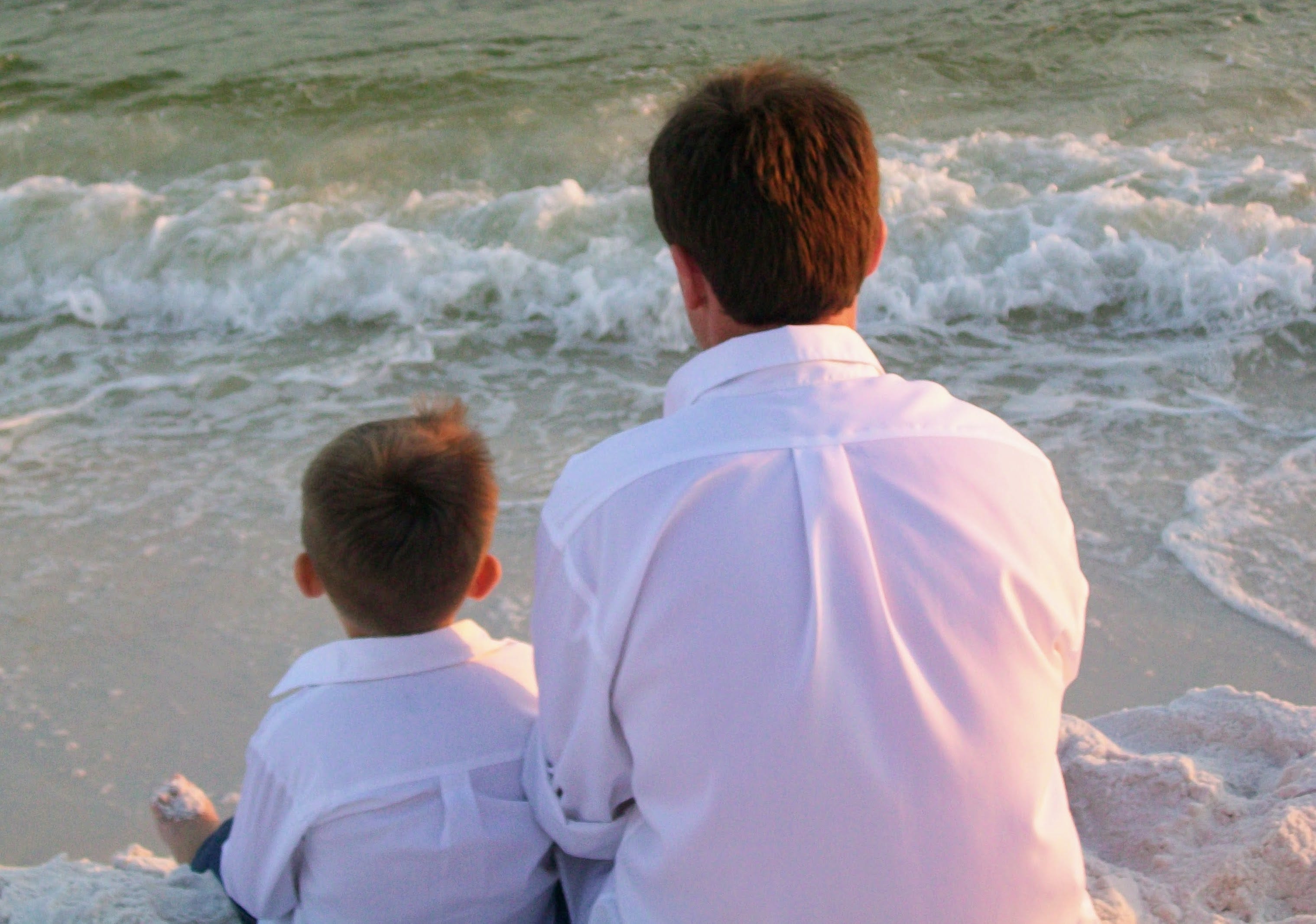
This devotional actually began with a conversation with my oldest son, Brighton.
He came home after studying the story of David and Absalom. He mentioned how David’s love for his rebellious son mirrored God’s love for us. I had read that account many times over the years. I’d always been fascinated by David’s response. Why would he tell his commanders to “deal gently” with a son who had betrayed him? Why would he mourn so deeply for someone who had tried to take his throne?
I’d spent years thinking about David’s heart.
What I had never stopped to consider was what David’s heart revealed about God’s.
Sometimes the people we’re trying to teach end up teaching us. This was one of those moments.
Every family has moments they wish they could take back.
Sometimes it’s a harsh word spoken in anger. Sometimes it’s a slammed door, a broken relationship, or years of distance that seem impossible to repair. If you’re a parent, you’ve probably discovered that your love for your children doesn’t disappear simply because they’ve made poor choices. In many ways, it grows stronger because you desperately want them to find their way back.
The story of David and Absalom is one of the most heartbreaking accounts in Scripture. It’s a story of betrayal, regret, and unconditional love. But it also points us to an even greater Father who loved His rebellious children enough to make a way for them to come home.
As you read today’s passage, pay attention to David’s heart. Then ask yourself what it reveals about the heart of God.
Read It
2 Samuel 18:5
“The king commanded Joab, Abishai, and Ittai, ‘Treat the young man Absalom gently for my sake.’ And all the people heard when the king gave all the commanders orders concerning Absalom.”
2 Samuel 18:33
After learning of Absalom’s death. “The king was deeply moved and went up to the chamber over the city gate and wept. As he walked, he cried, ‘My son Absalom! My son, my son Absalom! If only I had died instead of you, Absalom, my son, my son!’
Own It
As parents, we’ve all heard words we’d rather forget.
“I hate you.”
“I wish I lived somewhere else.”
“You’re the meanest dad ever.”
The first time you hear those words, they sting. You know they probably aren’t true, but they still hurt. Most of the time those words don’t come from hatred. They come from frustration, embarrassment, or a child who just discovered that Mom and Dad aren’t changing their minds.
The funny thing is, I can’t really hold it against them.
I remember doing the exact same thing.
Growing up, my brothers Sean and Andrew and I had our share of arguments. I remember one time telling Sean that we weren’t brothers anymore. Looking back, that’s one of the dumbest things I’ve ever said. You don’t stop being family because someone gets mad. You don’t erase years of love because of one heated argument.
Kids have a way of saying permanent things in temporary moments.
Now that I’m a dad, I’ve learned something.
After discipline or an argument, I usually don’t wait very long before I go back into my child’s room. I don’t want hurt feelings to have more time than they deserve. I don’t want distance to settle into a relationship that needs healing.
I usually sit down beside them, talk through what happened, and remind them of something they may not feel in that moment.
They’re still mine.
My love didn’t disappear because they made a bad decision.
In fact, moments like those probably make me want to reconnect even more.
Love and approval are not the same thing.
Some of the most loving words a parent can speak are, “I love you too much not to tell you the truth.” When my kids make choices that don’t honor God, they need me to lovingly point them back toward Him. Ignoring sin isn’t loving. Pretending wrong is right isn’t loving either.
Correction isn’t rejection.
It’s love with the courage to tell the truth.
I’ve told all four of my kids that there is nowhere they could ever be that would keep them from calling me. We even have a secret text code they can send if they ever find themselves somewhere they shouldn’t be. I’ll happily be the bad guy if it means getting them home safely. I never want fear or shame to keep them from reaching out for help. “Throw me under the bus all you want,” I’ve told them more than once.
I want them to know they can always come home.
Growing up around cattle taught me something about people too. Every now and then you’d have one that wanted to test the fence. It didn’t matter that the fence shocked it yesterday. Somehow it seemed to think today might be different. Sure enough, it would touch the fence again.
Sometimes we’re a lot like those cattle.
God gives us boundaries because He loves us, yet we still convince ourselves that maybe this time we’ll find something better on the other side. We test the fence over and over, wondering if life outside God’s design will finally satisfy us. Then ZAP!
That’s what Absalom did.
He wasn’t simply a rebellious son. He quietly stole the hearts of Israel, declared himself king, and forced David to flee Jerusalem. It wasn’t just family conflict.
It was treason. He broke the law. The big law.
By every human standard, David had every reason to protect his throne and demand justice. Instead, as his army marched into battle, David gave an unexpected command.
“Deal gently with the young man Absalom for my sake.”
That wasn’t simply the order of a king.
It was the plea of a father.
I’ve often wondered if part of David’s grief came from knowing he hadn’t always been the father he should have been. David made some painful mistakes with his family, and parents have a way of replaying those moments in their minds when relationships become strained. Whether those thoughts crossed David’s mind or not, one thing is certain.
He never stopped loving his son.
When Joab ignored David’s command and killed Absalom, David didn’t celebrate the end of the rebellion. He cried out, “My son Absalom! My son, my son Absalom! If only I had died instead of you.”
Every parent understands those words.
Love doesn’t disappear when your child disappoints you.
Then it hit me.
When I read this story, I’ve always imagined myself as David.
But that’s not who I am.
We are Absalom.
Every time I’ve chosen my own way over God’s, I’ve committed treason against the King of the universe. I’ve looked at His wisdom and decided I knew better.
Yet instead of abandoning me, He made a way for me to come home.
David wished he could take his son’s place.
Jesus actually took mine.
I’ve experienced a small picture of that kind of grace before.
When I was growing up, my brother Sean and I were throwing a baseball in the backyard like we had done dozens of times. It was a beautiful summer afternoon, and Sean, who was the best baseball player of the three of us, was working on scooping low throws at first base.
Or at least that’s what I tell myself. No idea honestly.
I threw one a little low. Maybe it took a bad hop. Maybe it skipped under his glove.
Either way...
The baseball rocketed straight into our sliding glass door.
It hit the bottom corner, and in an instant the entire pane turned into a giant spiderweb. There wasn’t a piece of glass bigger than a dime.
Sean and I just stood there staring at it.
Neither of us had to say a word.
We both knew exactly what we had to do next.
We walked inside, found Mama and Daddy, and told them what had happened.
We fully expected punishment.
Instead, we found understanding.
They knew we hadn’t been reckless.
It was an accident.
I’ve thought about that moment many times over the years.
How often do we approach God expecting anger when He’s already provided grace through Christ?
The difference, of course, is that my parents absorbed the cost of a broken window.
God absorbed the cost of our broken lives.
That’s why we don’t have to hide.
That’s why we don’t have to keep running.
Because Jesus already paid for what we could never fix ourselves.
Maybe that’s why I tell my own kids they can always call me.
Maybe that’s why I walk back into their room after hard conversations.
Maybe that’s why we have a secret text code if they ever need help.
I’m simply trying to reflect the heart of a Father who has spent my entire life reminding me of one beautiful truth.
Come home.
That’s the heart of our Father.
Live It
Ask yourself these questions today:
Have I confused God’s correction with His rejection?
Is there someone in my life who needs to know they are still loved, even while I disagree with their choices?
Am I making it easy for my children, spouse, or loved ones to come to me when they’ve made a mistake?
Is there an area where I need to stop running from God and simply come home?
Go Deeper
Read these passages and consider what they teach about the Father’s heart.
2 Samuel 18:5-33
Luke 15:11-32
Romans 5:6-11
John 10:27-30
As you read, look for the ways God pursues, forgives, protects, and restores His children.
Dinner Table Devotional
Ask everyone at the table:
Have you ever been afraid to admit you did something wrong? Why?
Then ask:
How does it change the way we think about God when we realize He wants us to come to Him instead of hiding from Him?
Remind your family that discipline is meant to restore, not destroy. A loving parent corrects because they care, and our Heavenly Father does the same.
Pray
Father,
Thank You for loving me even when I have acted more like Absalom than a faithful child. Thank You that Your love isn’t based on my performance but on Your grace. Help me never confuse Your correction with rejection. Teach me to reflect Your heart in my own family so that those I love always know they can come home. And when I wander, remind me that through Jesus, Your arms are still open.
In Jesus’ name,
Amen.
I'd love to hear from you. What's one way you've experienced the Father's unconditional love, or what's something you've learned as a parent about grace? Share your thoughts in the comments below.
Good word Maury and keep on striving to communicate grace and His ways to others.