


Have you ever noticed how quickly your mind can turn a small concern into a full-blown catastrophe?
One unexpected phone call. A strange pain. A conversation that doesn’t go quite the way you expected. Before long, your imagination has filled in all the blanks, and somehow you’ve convinced yourself that the worst-case scenario is no longer a possibility but an inevitability.
I know that feeling because I’ve lived it.
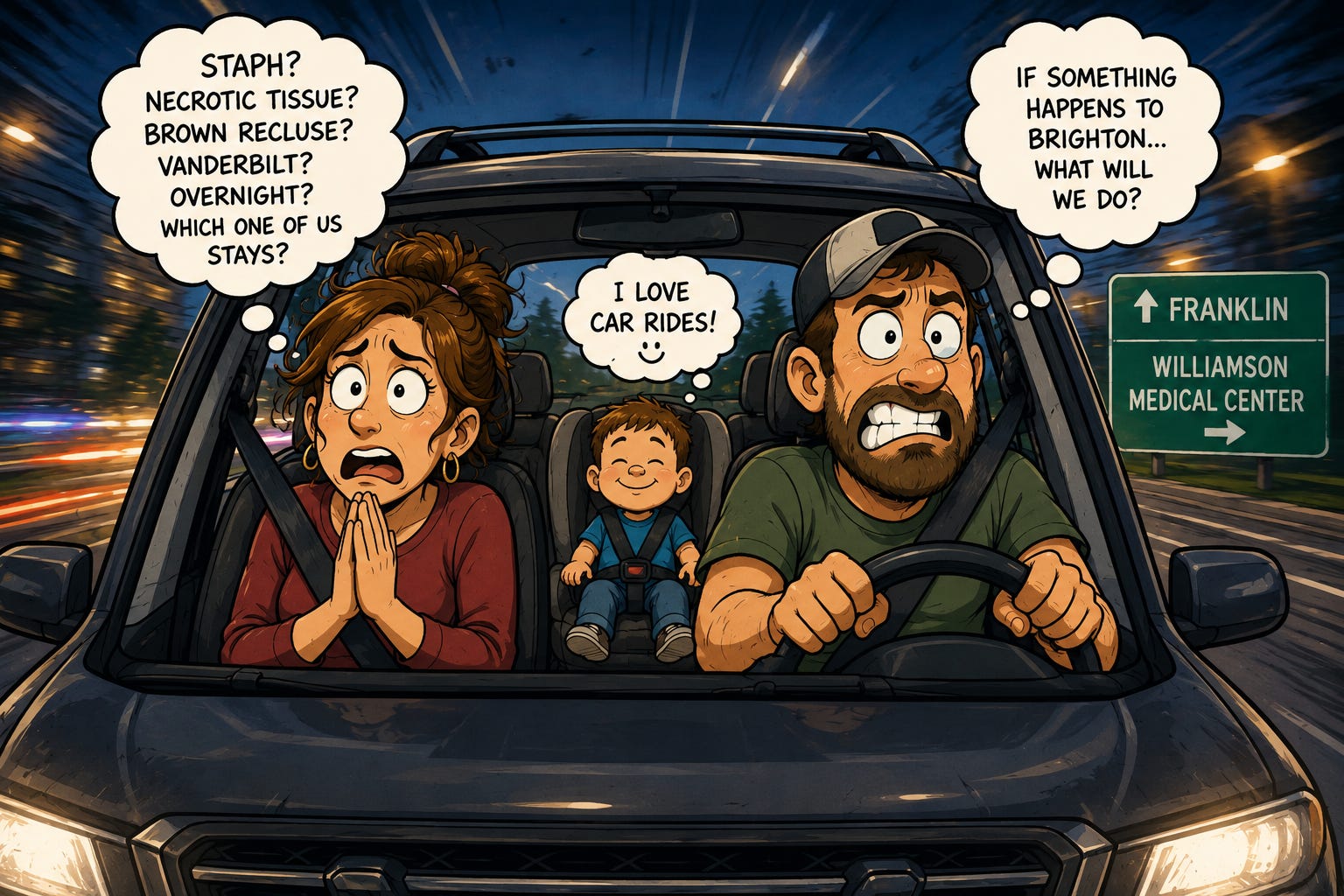
Years ago, Karen and I experienced our very first parenting panic. What started as a penny-sized spot on our three-year-old son’s leg sent us racing to Franklin, praying the whole way and wondering if our little boy was facing something life-changing. Looking back now, it’s one of those stories that makes us laugh. At the time, though, it felt anything but funny.
That night taught me something I’ve continued learning ever since: fear has an incredible ability to write stories that reality never tells. And more often than I’d like to admit, my imagination reaches the diagnosis long before God reveals the truth.
Paul’s words in Philippians remind me that God’s invitation isn’t to pretend difficult situations don’t exist. It’s to bring every anxious thought to Him before fear has the chance to finish writing the story.
Read It
Philippians 4:6–7 (CSB)
“Don’t worry about anything, but in everything, through prayer and petition with thanksgiving, present your requests to God. And the peace of God, which surpasses all understanding, will guard your hearts and minds in Christ Jesus.”
Own It
Every parent has a first freak out. Ours happened when Brighton was about three or four years old.
We were out running errands one evening when Brighton started complaining that his leg itched. At first, it didn’t seem like much. Kids scratch bug bites all the time. But when we finally got a good look at it in a store parking lot, Karen and I both stopped in our tracks.
There, on his leg, was a circular spot about the size of a penny. It had a bright pinkish-red ring around the outside, a dark blue circle just inside that, and a dark red spot in the very middle. Looking back now, I know exactly what we were seeing. Back then? I was convinced I was looking at rotting flesh.
Everything with Brighton was our first. Our first child. Our first fever. Our first late-night panic. We had no previous experiences to pull from, no parenting stories that ended with, “Oh, it’s probably nothing.” We were learning as we went, and every chapter felt like opening an instruction manual we’d never read before.
Karen and I looked at each other, both trying not to overreact while simultaneously overreacting in our own minds.
“What if it’s staph?”
“What if it’s necrotic tissue?”
“Isn’t that what kills people?”
The questions came much faster than the answers.
Instead of guessing, we started scrolling through our phone contacts looking for someone in the medical field. We found a nurse we trusted and called her. After listening to our description, she asked us to text her a picture of the spot with a coin beside it so she could judge the size. We grabbed a penny, laid it next to Brighton’s leg, snapped the picture, and hit send.
A few minutes later, my phone rang.
“You all probably need to get him to a doctor...ASAP.”
Those four letters changed everything.
I had been doing my best to stay calm for Karen, but the moment I heard that, I became a NASCAR driver.
The entire drive to Franklin felt like one long conversation built entirely on questions. If it was staph, what would they do? If it was a brown recluse bite, would they have to remove dead tissue? Would Williamson Medical send us straight to Vanderbilt? Would they keep him overnight? Which one of us would stay with him? Could we both stay?
Meanwhile, Brighton sat in the back seat acting like a perfectly healthy three-year-old whose leg happened to itch.
Karen prayed almost the whole drive. She prayed that God would heal our little boy, protect him, guide the doctors, and calm our hearts. I prayed too, but if I’m honest, my mind kept trying to outrun God. I was answering “what if” questions that hadn’t happened yet. I was mentally preparing for a future that existed only in my imagination.
By the time we arrived, the emergency room was packed, and they told us that if it looked as serious as we described, they’d probably send us to Vanderbilt anyway. We found a walk-in clinic that was about to close for the evening, and thankfully they agreed to see us.
The doctor walked in with a level of calmness that honestly frustrated me. Looking back, it’s funny. At the time, I was thinking, “Sir, where is your sense of urgency? Our son’s leg could be rotting away while you’re casually introducing yourself.”
He leaned over, looked at the spot for a few seconds, and finally said, “Let’s clean it off and get a better look.”
Cleaning it off?
That had honestly never crossed our minds.
We thought if we touched it, we might make things worse.
The doctor put a little white cream on a cloth and gently wiped across the spot. Once. Then again.
Karen and I watched in complete silence.
The blue started disappearing.
Wait...
Was that...
Blue jean lint?
The doctor smiled.
“He’s got ringworm.”
That was it.
Ringworm.
No staph.
No necrotic tissue.
No Vanderbilt.
No overnight hospital stay.
No life-changing diagnosis.
Just ringworm.
The red circle was exactly what it appeared to be all along. The “dead tissue” we’d been convinced we were looking at turned out to be nothing more than lint from the inside of Brighton’s blue jeans that had collected because he’d been scratching his leg all afternoon.
Karen and I looked at each other and immediately felt two emotions at the same time: overwhelming relief... and just a little bit of embarrassment.
We called our parents to let them know everything was okay.
“It was just ringworm.”
The nurse who had told us to get him to a doctor laughed when we updated her, but she also admitted she’d have sent us too after seeing the picture. And Brighton? He looked at both of us with an expression that seemed to say, “Can we go home now?”
Years later, I can laugh about that night.
Not because we cared too much.
But because we loved our son so much that our imagination outran reality.
Reflect
As funny as that story is now, I’ve realized over the years it wasn’t just teaching us how to be parents. God was teaching us something about fear.
Fear has a remarkable ability to color what we’re looking at until we can no longer see it clearly. It’s like pouring gasoline on the flames of our imagination. We don’t simply prepare for what might happen. We begin living as though it already has.
The funny thing is, I still catch myself doing it.
A few months ago, I woke up in the middle of the night with a minor health issue. Before long, my imagination was writing another horror story all its own. I started thinking about Karen. I thought about our four kids. I wondered what would happen if something was seriously wrong.
I wanted to wake Karen up, but instead I prayed. I asked God to heal me. I asked Him to calm my heart. By morning, I went to the doctor, got checked out, received some medicine, and within a short time the problem was gone.
As I drove home, I couldn’t help but think back to Brighton’s ringworm.
Once again, my imagination had been a ten.
Reality had been about a three.
I wonder how often we do that.
We spend so much time fearing what might be that we lose sight of what actually is. We borrow tomorrow’s troubles before they ever arrive. We rehearse conversations that never happen. We brace for diagnoses we never receive. We convince ourselves that because something resembles disaster, disaster must be inevitable.
Paul understood anxious hearts when he wrote Philippians 4. He didn’t promise that life would never give us reasons to worry. He simply reminded us where our worry belongs.
Take it to God.
Notice what God promises in return.
Not immediate answers.
Not immediate healing.
Not immediate solutions.
Peace.
Sometimes peace is the first miracle God performs.
Looking back now, Karen and I don’t panic quite as quickly. Part of that comes from raising four kids. Experience has taught us that not every rash is an emergency, not every fever is catastrophic, and not every difficult season ends in disaster.
But I think something else has changed too.
My faith has grown.
I’ve watched God carry our family through too many situations to ignore His faithfulness. I’ve learned that everything isn’t a disaster, even when it feels like one in the moment. I’ve also realized that as a husband and father, my family often borrows my calm. That doesn’t mean I never get scared. It means I’ve learned where to take my fear.
Sometimes God removes the problem.
Sometimes He simply reminds us that fear has been telling us a story that isn’t true.
Live It
Is there something in your life right now that your imagination has turned into a catastrophe?
Before you let fear finish writing the story, take it to the One who already knows the ending. Ask God for wisdom. Ask Him for peace. Ask Him to help you see your circumstances through the eyes of faith instead of the lens of fear.
You may still have a difficult road ahead.
Or you may discover that what looked terrifying simply needed to be cleaned off so you could finally see it clearly.
Dinner Table Devotional
Have you ever worried about something that turned out to be much smaller than you imagined?
Why do you think our minds naturally jump to worst-case scenarios?
What does it look like to pray before we panic?
Pray It
Father, thank You for caring about the things that keep us awake at night. Forgive me for the times my imagination runs ahead of my faith. Help me bring my fears to You before I let them grow into something they were never meant to become. Fill my heart with Your peace, give me wisdom for today instead of worry about tomorrow, and help me become a calming presence for the people You’ve entrusted to my care. Amen.
Great post, Maury. Given my tendency to go from 0 to Apocalypse in seconds, Philippians 4:6-7 is the cornerstone of my memory verses! Thanks for sharing this!
I’m so grateful for God’s peace that is beyond human comprehension! Too often we focus on our problems instead of focusing on God.