


Before every baseball game in high school, we did the same thing.
After we finished warming up, we gathered at the end of the dugout, formed a circle, and knelt with our heads bowed and our hats in our hands. I usually led the prayer. I was the guy who went to church, so apparently that made me the team chaplain.
“Our Father, who art in heaven, hallowed be Thy name. Thy kingdom come, Thy will be done…”
I knew the words. I had said them plenty of times before, and even then I was thinking about what they meant, at least a little.
Part of the reason I remember it so clearly is what happened immediately afterward. We would stand up and launch into a team war chant that included a word I refused to say. I would say everything else and conveniently leave that particular word out.
Even as a teenager, the contradiction bothered me. We had just knelt together and prayed to God, and now we were yelling something that didn’t exactly sound like it belonged in the same conversation.
The prayer was rehearsed and monotone. The war chant was yelled with energy and raised voices. I remember thinking that God wasn’t going to bless our baseball game just because we had said the Lord’s Prayer before the first pitch.
Odds are, for some of us in that circle, that was the only prayer said all week. Sobering thinking about that now.
This week at church, we began a series on the Lord’s Prayer, starting with the first words Jesus taught His disciples to pray.
Matthew 6:9–10: “Our Father in heaven, hallowed be Your name. Your kingdom come. Your will be done on earth as it is in heaven.”
During our Life Group discussion, a gentleman in our group named Rusty shared a simple way he had been taught to think about prayer:
P.R.A.Y.—Praise, Repentance, Ask, Yield.
I like that. Especially where it starts and where it ends.
Prayer begins by turning our attention toward God, and it ends with surrendering ourselves to Him.
We also talked about how easy it is to treat prayer like 911. Something goes wrong, life gets scary, the diagnosis comes, the money isn’t there, one of the kids gets hurt, and suddenly we remember that we should probably pray. But prayer was never meant to be an emergency number we keep around just in case everything else fails. It should be our first response.
I learned something about that pretty early in adulthood.
I bought my first house in October 2000. A few months later, I opened the mail and found a tax bill I wasn’t expecting. When I bought the house, I had specifically asked for the taxes to be included in my mortgage payment. I was young, living in my first house, and I certainly hadn’t been putting money aside for a tax bill I thought I was already paying.
It was an emergency to me, and I needed help. So before I picked up the phone, I prayed.
Then I called the mortgage company. They admitted they had made a mistake, and, like God has done more than once in my life, He didn’t simply provide a way through the problem. I ended up in a better situation on the other side of it. I was able to refinance the house for the same term at a lower interest rate and take care of the bill.
God is so good.
But there’s something I understand now that I probably didn’t understand nearly as well in my twenties: God would have still been good if His answer had looked different.
That’s where prayer gets harder.
When the disciples asked Jesus to teach them to pray, He didn’t begin with a list of everything they needed. He began with God: “Our Father in heaven, hallowed be Your name.”
Before Jesus gets to “give us,” He teaches us to praise. Before the needs, worries, problems, decisions, and things keeping us awake at night, He points our attention toward the Father.
That changes our perspective. Prayer stops beginning with everything that is wrong with my life and starts with what is true about God. He is good, faithful, present, and worthy of praise even when there are things happening around me that I desperately want Him to change.
That doesn’t mean we pretend everything is fine. It means we refuse to let everything that isn’t fine become bigger in our minds than the God we’re talking to.
God isn’t a genie waiting for us to say the right words so He can grant our wish. I think I understood a little bit of that kneeling next to a dugout all those years ago. Saying the Lord’s Prayer before a baseball game didn’t obligate God to help us win. The other team was probably asking God the very same thing.
Prayer isn’t about convincing God to get behind my plans. It’s about getting my heart aligned with His.
And that brings us to the part I’m still learning how to pray.
“Your kingdom come. Your will be done.”
There is something incredibly freeing about saying, “Thy will be done,” and there is something incredibly scary about it at the same time. Both feelings come from the same truth: I am not ultimately in control.
Marriage began teaching me that. Fatherhood really drove the lesson home.
When you’re only responsible for yourself, it’s easier to maintain the illusion that you have everything under control. Then you get married. Then children come along. Suddenly there are people walking around outside your house carrying enormous pieces of your heart with them, and you discover pretty quickly how little you actually control. Your needs also take a backseat to theirs a lot of times.
Let one of my kids get sick or hurt and my brain can come up with every possible outcome in about three seconds. That’s when “Thy will be done” becomes more than something I recited with my baseball team.
I know God is in control, and there is tremendous peace in that. What I don’t know is His plan, and that’s the scary part. Is He going to answer the way I’m hoping? Is He going to fix this the way I would fix it? Or is there another way I can’t see yet?
Surrender means trusting God before I know the answers to those questions.
Earlier this year, I wrote an article called Two Gardens. I wrote about Eden, where Adam and Eve hid when God came calling, and the garden outside the empty tomb, where Mary heard Jesus call her name and stepped toward Him.
But as we talked Sunday about the words “Your will be done,” my mind went to another garden.
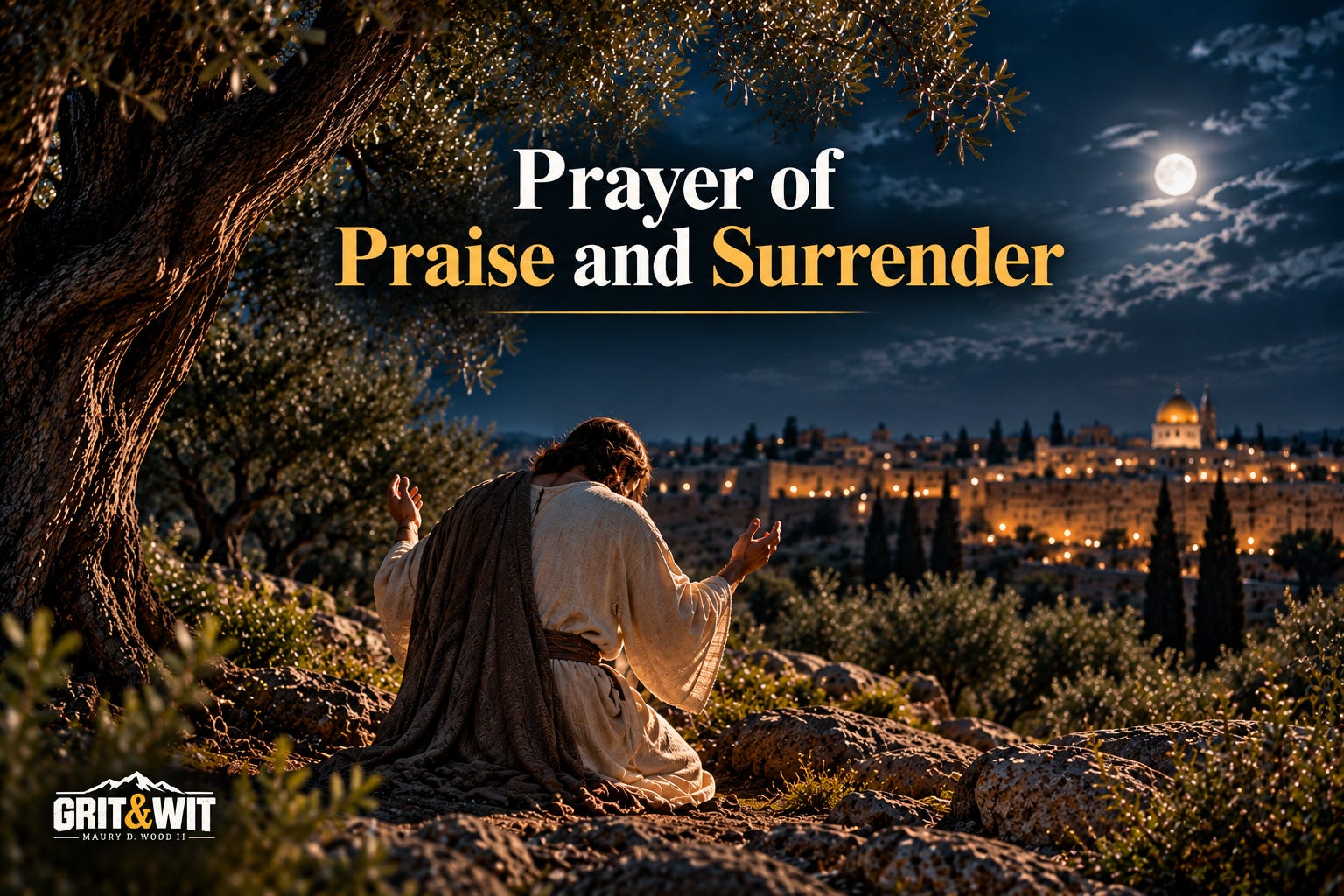
Gethsemane.
Jesus didn’t just teach His disciples to surrender to the Father’s will. When the time came, He did it Himself.
He knew what was coming. He knew the suffering ahead of Him, and in that garden Jesus prayed that if there were another way, the cup might pass from Him. Yet He surrendered to the Father’s will.
Jesus lived the prayer He had taught.
There is a world of difference between saying “Thy will be done” when everything is going the way we hoped and saying it when we desperately want God to choose another way. Surrender doesn’t mean we stop asking God for what we want. Jesus didn’t. It means we trust our Father enough to tell Him what we want and then yield the outcome to Him.
That brings me back to P.R.A.Y.—Praise, Repentance, Ask, Yield.
Maybe there is more packed into that little reminder than I first realized. We begin by remembering who God is, and we finish by remembering that He is God and we are not. Somewhere between those two things, we bring Him everything: the unexpected bills, the sick kids, the decisions we don’t know how to make, the fears we don’t like admitting, the things we desperately want Him to fix, and even the things we’re afraid He might ask us to walk through.
Maybe that’s where prayer really begins.
“Our Father…”
Not with an emergency number or a wish list, but with a relationship. And because we know the Father we’re talking to, we can learn to say the words that can be both freeing and frightening:
“Thy will be done.”
Live It
Before you ask God for anything today, stop and praise Him. Name something about who He is that you are grateful for.
Then think about the thing you’ve been asking Him to change. Ask for what you need. Be honest about what you hope happens. There’s nothing wrong with telling your Father what you want.
Then try adding four words: Thy will be done.
Not because you don’t care about the outcome, but because you trust the One who holds it.
Go Deeper
When something goes wrong, is prayer usually my first response or something I turn to after I’ve tried everything else?
What do I have to praise God for right now before I ask Him for anything?
Is there something I’m asking God to bless when I really need to surrender it?
Why does “Thy will be done” feel freeing in some situations and frightening in others?
Do I trust God’s character even when I don’t understand His plan?
Dinner Table Devotional
Read: Matthew 6:9–10
Talk About It:
Why do you think Jesus taught us to begin prayer by praising God instead of immediately asking for things?
What’s something our family can praise God for today?
What do you think it means when we pray, “Your will be done”?
Why can trusting God’s plan sometimes be difficult?
Pray Together:
Father, thank You for who You are and for the ways You care for us. Help us come to You first instead of only when we don’t know what else to do. Teach us to trust You enough to ask honestly for what we need and still say, “Your will be done.” Amen.
One more thing before I go. This happens to be the 100th Grit & Wit article I’ve published.
I thought about doing something special for number 100. I could have looked back, counted milestones, or written about what I’ve learned along the way. But that didn’t feel right.
Maybe the best way to mark one hundred is simply to write another article.
That’s what I’ve tried to do here. Tuesday after Tuesday, I tell a story, share what God is teaching me, hit publish, and then come back the next week and do it again.
After one hundred of these, I’m still learning. And this week, I’m still learning to mean four words I’ve been saying since I was a teenager kneeling at the end of a dugout:
Thy will be done.
See you next Tuesday. Have a blessed week!
A good word on prayer and an excellent topic to discuss for a 100th post in my opinion.